

 Published Sep 18, 2024


Mallory Crusta / Cats.com
After researching the market, reading product roundups, scouring customer reviews, and testing the top pet trackers, we’ve chosen the Tractive GPS Cat LTE + Tracker as the overall best GPS cat tracker you can buy.
The Tractive LTE GPS cat tracker has just about everything we’d want in a GPS tracker for cats. It’s lightweight, slim, and sits comfortably on your cat’s neck. Despite its size, this small unit contains a lot of powerful technology. Fully equipped with virtual fences, live tracking, location history, and a “find mode” that allows you to pinpoint your cat’s location, the Tractive app has everything you need to keep track of your cat wherever they go.
At a Glance: 9 Best Cat Trackers To Buy


Want a quick look at the products reviewed in this article? In the comparison table below, we’ve highlighted some of the most important features of each product. You’ll find more detailed information about each product later in the article.

Tractive GPS Cat LTE + Tracker
- No distance or range limitations
- Virtual fence to keep cat protected
- Affordably priced

Jiobit GPS Pet Tracker
- Reliable, accurate GPS tracking in Live Mode
- Lightweight, durable, and water-resistant
- Can be attached to your cat’s current collar

Eureka Marco Polo Advanced Pet Tracker
- Track multiple pets with ease
- No monthly charge to use
- Self-contained, no GPS or cell network needed
Loc8tor Tabcat RF Tracker
- Easy to attach, activate, and use
- Provides accurate directional info
- Works both indoors and outdoors

Cat Tailer Bluetooth Tracker
- Very small and lightweight
- Extremely easy-to-use app
- Find your cat in the house/yard

Tile Mate Bluetooth Tracker
- Works indoors and outside
- One of the cheapest options
- Reliable and accurate indoors
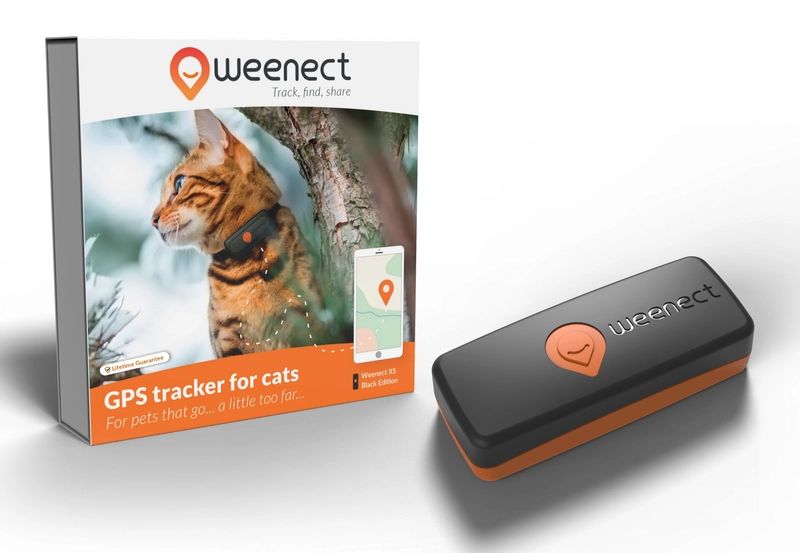

Weenect 2 GPS Tracker
- Shows location in real time
- View activity level, location history, and distance traveled
- Long battery life up to 72 hours
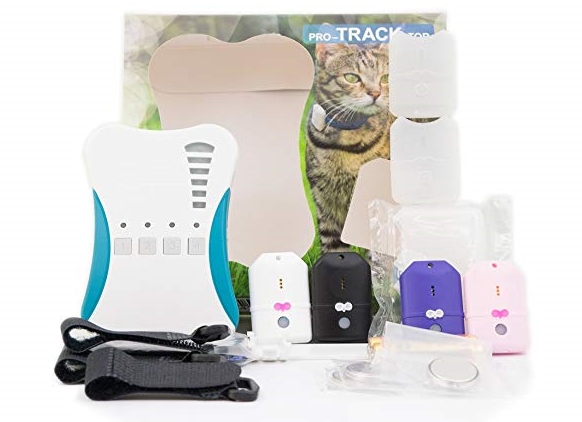

Girafus Pro-Track-Tor RF Tracker
- Exceptional 1,600ft range
- Battery life up to 30 days
- High level of accuracy
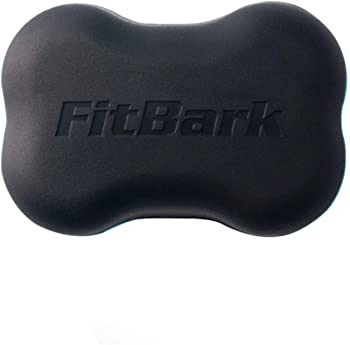

Fitbark GPS Tracker (2nd Gen)
- One of the lightest pet trackers on the market (16g)
- Accurate live tracking on LTE cellular network with Verizon, AT&T, and T-Mobile
- Improved battery life with 2nd Generation, up to 60 days on a single charge
Top Picks Explained
Before we review the Tractive GPS Cat LTE + Tracker and the rest of our top recommendations, let’s go over a few of the things you need to look for in a tracker.
Why Should You Trust Us?
Over the last several years, we’ve written in-depth reviews on dozens of pet tech solutions. From automatic litter boxes to pet fountains and feeders, our experts have spent hundreds of hours testing these products’ performance, user experience, and cat-friendliness.
In addition to our own product research and testing, we’ve read hundreds of customer reviews and consulted veterinary experts and cat behaviorists for insight into what to look for when evaluating these products.
Based on extensive research, hands-on testing, and expert insights, we selected the following nine cat trackers as the best you can buy.
How We Tested
We spent hours researching the different types of cat trackers, exploring the options on the market, and reading hundreds of customer reviews. Most of the products on this list have been tested in-depth by our Head of Content, Mallory, with her two cats, Wessie and Forest.
The cat trackers we tested were purchased at full retail price and the entire testing process was funded by Cats.com without direct input or influence from the companies involved.
To evaluate the cat trackers on this list, we performed in-depth testing to determine how easy they were to set up and how well they performed in various real-world applications. We tried the trackers with different types of collars to gauge their comfort and security.
What To Look For in a Cat Tracker
1. Reliable, Accurate Tracking Is Essential.
Though they’re not a substitute for microchipping and close supervision, cat trackers can help you keep tabs on your cat when he’s out of sight. With a reliable, accurate tracker, you’ll know when your cat strays from home, where he’s gone, and which direction you need to go to find him.
The best cat trackers have long battery lives, reliable connections, and ranges large enough to help you find your cat, whether he’s lounging on the porch or exploring blocks away.
2. The Best Trackers Have Functional, Intuitive Apps or Receivers.
Great trackers make it easy to keep tabs on your cat. Whether in the form of a phone app or a standalone handheld module, the receiver should be straightforward and easy to use.
The trackers we tested earned extra points for systems that included night lights, behavior change alerts, and other fun features, but some in-app features are indispensable.
For example, GPS tracking apps need virtual fences or safe zones. These alert you when your cat wanders too far from home or out of a designated area. Ideally, these fences are customizable, allowing you to set up safety zones that follow the lines of your backyard or other areas.
3. They’re Small, Lightweight, and Attach Easily to Your Cat’s Collar or Harness.
Most cat trackers are made with dogs in mind, so they’re often clunky, heavy, or built into collars that don’t feature quick-release buckles. Whether designed specifically for cats or not, the best trackers are lightweight enough for your cat’s comfort and compatible with his collar or harness.
Cat Trackers Use One of Three Tracking Technologies: GPS, Radio Frequency, or Bluetooth.
Global Positioning System (GPS) Cat Trackers
GPS is a global navigation system that uses satellites to provide location data to receivers around the planet.
Of the types of cat trackers available, GPS trackers provide the strongest visual location data—they display your cat’s general location on a map and have the longest detection range out of all the products on the market. Many GPS trackers can transmit signals to your phone from miles away.
These trackers connect to an app on your phone, through which you can create safe zones, watch your cat’s activity over time, view your cat’s real-time location on a map, and, with some trackers, gain insights into your cat’s health. Some trackers act like fitness trackers, giving you reports about your cat’s daily calorie burn, hours of rest per day, and more.
As exciting as GPS trackers are, they’re not perfect on all counts.
Because they rely on satellite transmissions, they don’t work if something is blocking their connection to the sky. GPS trackers don’t work indoors, and they might be unreliable under the cover of thick brush, trees, or even heavy clouds.
GPS trackers tend to be larger and heavier than other trackers as well, so they may be uncomfortable for some cats. Most are rated for cats weighing 8 lbs or more.
Additionally, GPS trackers are the most expensive type of pet tracker you can buy, with most costing between $70 and $200. Plus, most of them require a data plan, which will cost up to $10 per month.
Radio Frequency (RF) Cat Trackers
RF trackers feature a radio transmitter that attaches to your cat and a receiver that you carry. When the receiver detects your cat’s radio transmission, it will start beeping and lighting up, telling you the transmitter is within range. As you move closer to your cat, the signal changes, telling you you’re headed in the right direction.
While GPS trackers can estimate a cat’s location to within a few yards, an RF tracker will pinpoint your cat’s location down to a few centimeters. These trackers work both indoors and outside and have no problem transmitting through dense undergrowth, floorboards, or walls. They’re lightweight, streamlined, and have long-lasting batteries that should stay strong for months.
But for all the strengths of such a straightforward locating system, RF trackers look like rudimentary tools compared to GPS trackers.
They won’t alert you if your cat goes missing. They won’t give you a visual overlay of your cat’s location on a map. Worst of all, they seldom detect anything further than 1,600 feet away, demanding a slow, steady trial-and-error approach to finding a lost cat.
Most RF cat trackers go for around $100.
Bluetooth Cat Trackers
Bluetooth cat trackers have a few great qualities. They’re cheap, lightweight, and measure battery life in months rather than hours. But those are the only things they have going for them.
Bluetooth trackers are the weakest option available. With a range of no more than 300 feet, Bluetooth trackers will help you find your cat when she’s hiding under the bed or playing on the deck. But if your cat gets lost, a Bluetooth tracker isn’t usually much more helpful than your own pair of eyes.
After researching cat trackers and reading customer reviews, we chose the following eight trackers for hands-on testing.
Our nine candidates are popular products that have generated a lot of conversation on the web. They include products from all three tracker categories: GPS, RF, and Bluetooth.
Those nine cat trackers are:
- Tractive GPS Cat LTE + Tracker
- Girafus Pro-Track-Tor RF Tracker
- Loc8tor Tabcat RF Tracker
- Cat Tailer Bluetooth Tracker
- Tile Mate Bluetooth Tracker
- Eureka Technology Marco Polo Tracker
- Jiobit GPS Pet Tracker
- Weenect 2 GPS Tracker
- Fitbark GPS Tracker
Best Cat Trackers Comparison Chart
| Product Name | Type of Device | Weight | Battery Life | Includes App | Accuracy Level | Price | Warranty |
| Tractive GPS LTE+ Tracker | GPS | 1.76 ounces | 2-5 days | Yes | Mid | $57.99 | 1-year |
| Jiobit GPS Tracker | GPS | 0.6 ounces | 7 days | Yes | High | $149.99 | 1-year |
| Eureka Marco Polo Tracker | Self-Contained | 0.8 ounces | Up to 45 days | No | High | $274.95 | 90 days |
| Loc8tor Tabcat RF Tracker | Radio Frequency | 6 grams | 4-12 months | Yes | High | $99.99 | 2-year |
| Cat Tailer Bluetooth Tracker | Bluetooth | 7.9 grams | 6 months | Yes | Low | $67.00 | 1-year |
| Tile Mate Bluetooth Tracker | Bluetooth | 6.1 grams | 12 months | Yes | Low | Check At Amazon | 1-year |
| Weenect 2 GPS Tracker | GPS | 25 grams | 3 days | Yes | High | Check At Amazon | 2-years |
| Girafus Pro-Track-Tor RF Tracker | Radio Frequency | 4.2 grams | Up to 30 days | Yes | High | $109.99 | N/A |
| Fitbark GPS Tracker (2nd Gen) | GPS | 16 grams | 10-60 days | Yes | Mid | Check At Amazon | 1-year |
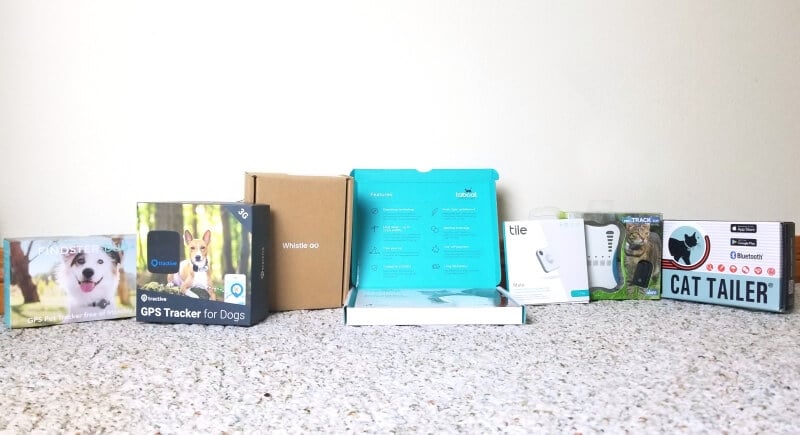
After receiving the trackers, I subjected them to a series of tests.
Mallory Crusta / Cats.com
First, I tested their ease of assembly and setup.
I ran a stopwatch while getting the trackers set up.
While assembly, app installation, and setup were effortless, the GPS trackers had the longest wait time before they were ready to use. All of them needed to charge for a few hours before they would work.
On the opposite end of the spectrum, the Tile Mate Bluetooth Tracker took the shortest time from unboxing to cat tracking. With a visit to the Google Play store and the press of a button, the Mate was ready to go within a few minutes.
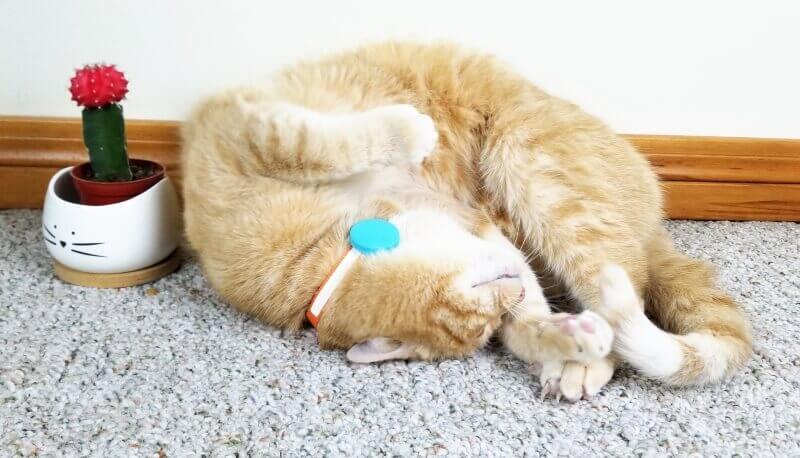
Next, I let my cats try the trackers on to test their comfort and security.
Mallory Crusta / Cats.com
Like harnesses, collars, and clothes, I was concerned that the tracking devices might overwhelm a feline wearer.
Of our test trackers, only two were made specifically with cats in mind. The others are primarily geared towards dogs or, in the case of the Tile, keys and other inanimate objects.
To test the trackers’ comfort and cat-friendliness, I enlisted the help of my two cats, Forest and Wessie. Forest is a 7-lb lightweight, while Wessie weighs 13 lbs. Neither of them wears collars around the house, so I didn’t know how they’d react to having a tracker strapped to their necks.
To my surprise, neither cat seemed to mind—or even notice—the trackers. From the bottle cap-sized Cat Tailer to the clunky 1.2-ounce Tractive, none of the trackers slowed them down.
Were the trackers easy to put on and secure enough to stay attached to a collar?
Whether they used key rings, plastic mounts, or rubber attachment loops, all of the trackers attached securely and easily.
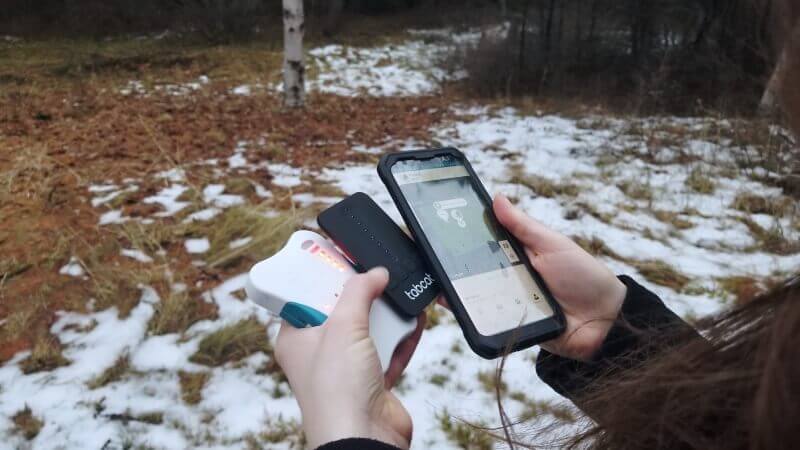
Finally, I subjected the trackers to two field tests.
Mallory Crusta / Cats.com
After watching my cats wear their trackers around the house, setting up data plans, and getting familiar with the apps and receivers, it was time to put the trackers to the test. I tested the trackers in a rural, partially forested area with decent cell coverage.
First, I tested the GPS trackers’ ability to keep track of movement by carrying all the trackers in my pocket and going for a walk.
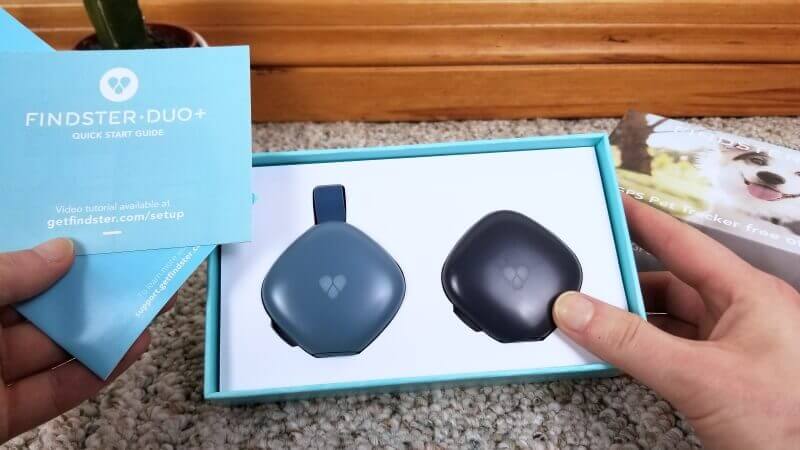
Because it updated frequently and provided accurate location data on the app, the Findster Duo+ was the clear winner of this GPS field tracker test.
The other GPS tracker didn’t update as frequently, so it lost some ground and failed to give an accurate location on the map. While the Findster Duo+ tracked the entire walk accurately, the other was still loading, refreshing, or trying to get a connection.
The Findster Duo+ was the clear winner in this GPS tracker test. But keeping tabs on your cat isn’t always as straightforward as taking a planned walk with your cat outside. I wanted to know what would happen if my cat escaped the house or wandered out of sight while wearing each of the trackers.
To test the trackers’ ability to come to the rescue in a surprise escape scenario, I played a game of cat tracker hide-and-seek.
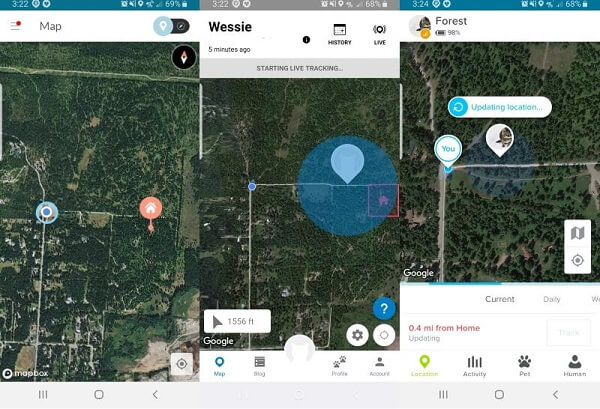
In this test, one person held the receiver—or smartphone, in the case of the GPS trackers—while another played the role of a runaway cat, taking the trackers to secret spots outdoors.
Only three of the trackers were able to locate the “lost cat.”
The Girafus Pro-Track-Tor and Findster Duo+ did well in this test, each reuniting tracker and receiver within six minutes.
By the time the Loc8tor Tabcat started alerting, I’d already spotted my test partner through the woods. Though it quickly brought me to the target once it was within the 400-foot range, it’s hard to say what would have happened if I’d been searching for a small, frightened cat.
Our two Bluetooth-powered competitors did the worst in this test.
After two minutes out of sight, my testing partner had moved out of the Bluetooth range and I had nothing to work with—they wouldn’t connect until the tracker was within my line of sight. While the Cat Tailer sends notifications when your cat leaves the Bluetooth range, the connection was so inconsistent that I wouldn’t be able to differentiate between a bad connection and a cause for alarm.
Though it worked well in our initial tracking test, the Findster Duo+ simply isn’t made for door dashes.
The device is designed for walks, so it doesn’t track your cat unless you’ve started a walk in the app. If you haven’t started a walk, a cat wandering two meters or more from the app will disconnect, leaving you without any way to monitor your cat’s activity.
Based on field testing, I wasn’t satisfied that the options I tested were the overall best, so I conducted a little more research.
That brings us to my top pick for the best RF tracker, the Eureka Marco Polo Tracker.
This pet tracker is designed with a self-contained system that doesn’t require GPS or a cellular network to use it. It features durable construction, a long 45-day battery life, and the ability to work with more than one pet. We also appreciated that it doesn’t require a monthly subscription fee.
Now, let’s take a closer look at my top 9 overall picks for the best cat tracker.
Best Cat Trackers: Our Top 9 Picks Reviewed
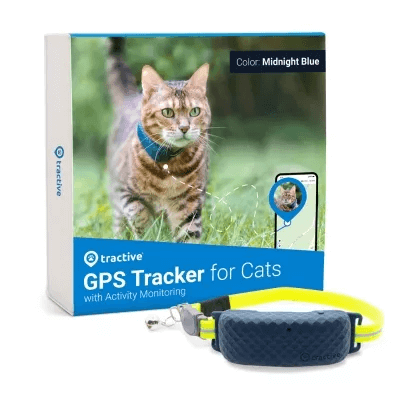
#1 Overall Best GPS Tracker: Tractive GPS Cat LTE + Tracker
- Type of Device: GPS + LTE
- Weight: 1.2 ounces
- Battery Life: 7-day battery life
- Includes App: Yes
- Accuracy Level: High accuracy
Newly upgraded, the Tractive GPS Cat LTE + tracker uses LTE cellular technology to track your cat’s location via GPS. It has all the features we look for in a good GPS tracker, like the ability to create custom fences and receive alerts via mobile app when your cat strays from home.
The Tractive app is functional, intuitive, and readable. One of the more interesting functions of the device is a remote-activated LED light. When you press a button in the app, a light on the tracker will turn on. This function is helpful when you’re searching for your cat in the dark.
The Tractive updates once every 2 to 60 minutes in default tracking mode and every two to three seconds in live mode. If you’re trying to find your cat, you can use live tracking to narrow in on their location, then activate Find mode. The closer you get to your cat, the more rings will appear on the screen. You can also activate the collar’s LED light or a sound indicator from here.
The tracker itself has been redesigned with a curved shape to make it more comfortable for your cat. The lightweight device (just 1.2 ounces) is easy to attach to your cat’s collar. Or you can purchase it with a weight-adjustable Rogz breakaway collar.
Although the new model offers beneficial features like a Wi-Fi power-saving device (it uses less battery on Wi-Fi), it doesn’t come with a spare battery like the previous model. The new model does offer up to 7 days of battery life, however, which is an improvement over the prior mode’s 2- to 3-day life.
What We Liked:
- Works over any range, with no distance limitations
- Uses virtual fences and sends alerts to your phone
- Wi-Fi power-saving device and 7-day battery life
- One of the most affordable GPS trackers
- Has an LED for finding your cat in dark places at night
What We Didn’t Like:
- Requires cell coverage to work consistently
- Requires a data plan, ranges from $5-13 per month
- New model doesn’t come with a spare battery
#2 Runner-Up: Jiobit GPS Pet Tracker
- Type of Device: GPS
- Weight: 0.6 ounces
- Battery Life: 7-day battery life
- Includes App: Yes
- Accuracy Level: High accuracy
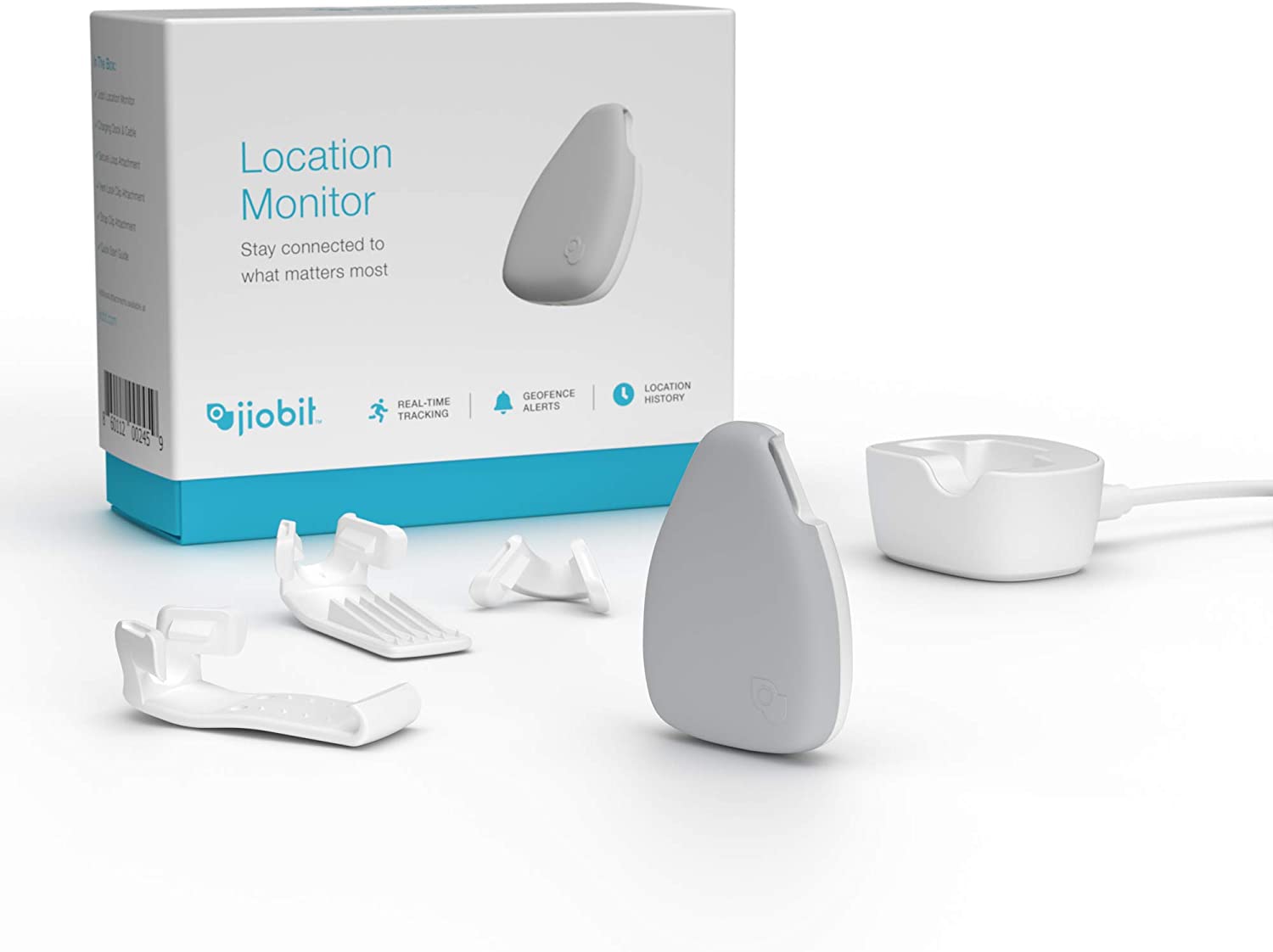
Originally developed for kids, the Jiobit GPS Tracker is now being marketed for pets. This tracker offers an excellent suite of features with reliable performance in a lightweight package.
This cat tracker utilizes GPS technology to deliver real-time, turn-by-turn tracking in Live Mode. In my hands-on testing, I found it to be incredibly accurate – potentially more accurate than the Tractive tracker. The virtual fence feature worked consistently as well. I received a notification immediately when the tracker moved outside the set boundary.
Another useful feature this tracker offers is Bluetooth connectivity. This enables you to use the tracker reliably in your home. You can even activate a sound indicator to reveal your cat’s location.
In terms of appearance, this tracker is small and simple. It clips onto your cat’s existing collar and, because it weighs only 0.6 ounces, it shouldn’t be too obtrusive. The tracker is water-resistant, and you can purchase a fabric sleeve if you want to dress it up a bit.
The Jiobit tracker has a longer-lasting battery than several of the other trackers I tested. Jiobit suggests that it takes about 2.5 hours to charge, and the unit can run for a full week on a single charge in optimal conditions.
Priced at $129.99, the Jiobit tracker is a little more expensive than some of the others on this list. On top of the unit itself, you’ll also need to pay upwards of $8.99 per month for the subscription.
What We Liked:
- Reliable, accurate GPS tracking in Live Mode
- Lightweight, durable, and water-resistant
- Can be attached to your cat’s current collar
- Long-lasting battery, up to 7 days on a single charge
- Bluetooth connectivity available for indoor tracking
What We Didn’t Like:
- Requires a monthly subscription plan upwards of $8.99
- Bluetooth connectivity can be spotty
#3 Best Radio Frequency Tracker: Eureka Marco Polo Advanced Pet Tracker
- Type of Device: Self-contained
- Weight: 0.8 ounces
- Battery Life: Up to 45 days
- Includes App: No
- Accuracy Level: High
- Warranty: 90 days
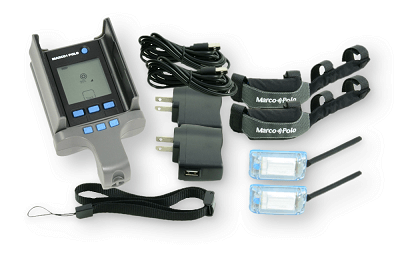
The Eureka Marco Polo Tracker is one of the most unique options we’ve reviewed. This pet tracker is different because it is a self-contained system that doesn’t require GPS or a cellular network to use. This means no monthly contracts, and it works well for traveling with your pet.
This pet tracker comes in a single-pet or multi-pet system, and you can always add more pets simply by purchasing a new tracking tag. These tags are durably constructed, and designed to withstand both rough terrain and submersion in water. It attaches to your cat’s collar using a rugged ballistic nylon holder that protects the device and keeps it securely in place. It has roughly a 45-day battery life.
With the Eureka Marco Polo Tracker, you can monitor your pet’s location in reference to four programmable safety zones, or activate the lost pet feature to track your cat using real-time distance and direction feedback.
Unlike many GPS trackers that use a smartphone app, the Eureka Marco Polo Tracker utilizes a handset locator that acts like a personal radar system, with a range of up to 2 miles in open conditions. This means if your cat is outside the system’s range you’ll have to walk or drive around to find them, but it works well if your cat doesn’t tend to wander too far.
Overall, the Eureka Marco Polo Tracker is a good option if you want to keep tabs on your cat’s location fairly close to home. Because this system doesn’t use GPS or cellular technology, your cat will need to be within 2 miles of the locator to find him, and rough terrain or weather could further limit that range. What makes this system unique is that you can travel with it and set up new safe zones anywhere you go. Plus, you’ll save money on monthly subscription fees.
What We Liked:
- Generous battery life up to 45 days on a single charge
- Set four “safety zones” to keep track of your pet
- Doesn’t require Wi-Fi, GPS, or cellular network
- Can be used with multiple pets, simply purchase additional tags
- One-time purchase price, no monthly subscription fees
What We Didn’t Like:
- Tracking system has a limited range
- Rough terrain and obstructions may further limit range
#4 Best Budget RF Tracker: Loc8tor Tabcat RF Cat Tracker
- Type of Device: Radio Frequency
- Weight: 4.2 grams
- Battery Life: 4-12 months
- Includes App: No
- Accuracy Level: High
- Warranty: 2-year
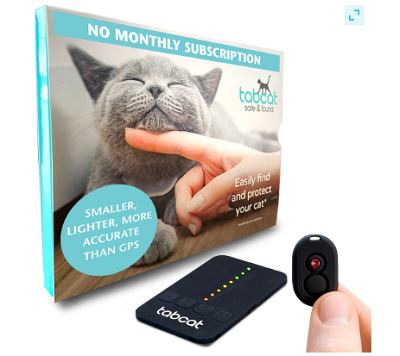
The Loc8tor Tabcat is a small, lightweight RF tracker that’s made specifically for cats. The tracker module sits in a rubber case and slips onto your cat’s collar, where it transmits to a handheld receiver device.
The handset’s strip of color-coded lights and beeping tone indicates whether you’re in range and how close you are to your cat. One handset pairs with up to four trackers, so it’s easy to outfit your entire fur family with Tabcat trackers.
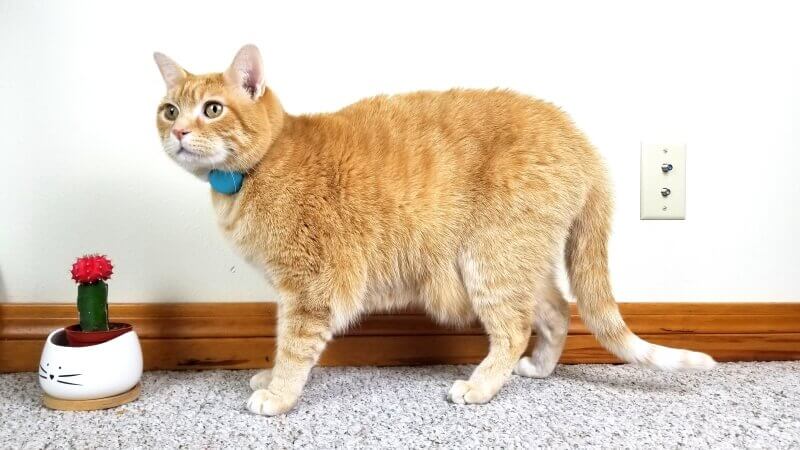
Loc8tor Tabcat RF Cat Tracker. Mallory Crusta / Cats.com
After a quick activation process, the tracker was ready to use. Using the handset was straightforward and intuitive, proving consistent and accurate in several tests around the house. During outdoor tests, it was less useful. Unlike a GPS tracker, which starts helping you navigate as soon as you’re ready to search, the Tabcat’s 400-foot range means that you’ll have to do some searching on your own before you get a reading.
Once it got into range, however, the Tabcat was spot-on, never failing to give an accurate reading.
What We Liked:
- Easy to attach, activate, and use
- Provides accurate directional information
- One handset works with up to four tracking modules
- One of the cheapest cat trackers you can buy
- Works both indoors and outside
What We Didn’t Like:
- Has a measly 400-foot range
#5 Best Bluetooth Cat Tracker: Cat Tailer Bluetooth Cat Tracker
- Type of Device: Bluetooth
- Weight: 7.9 grams
- Battery Life: 6 months
- Includes App: Yes
- Accuracy Level: Low
- Price: $67.00
- Warranty: 1-year
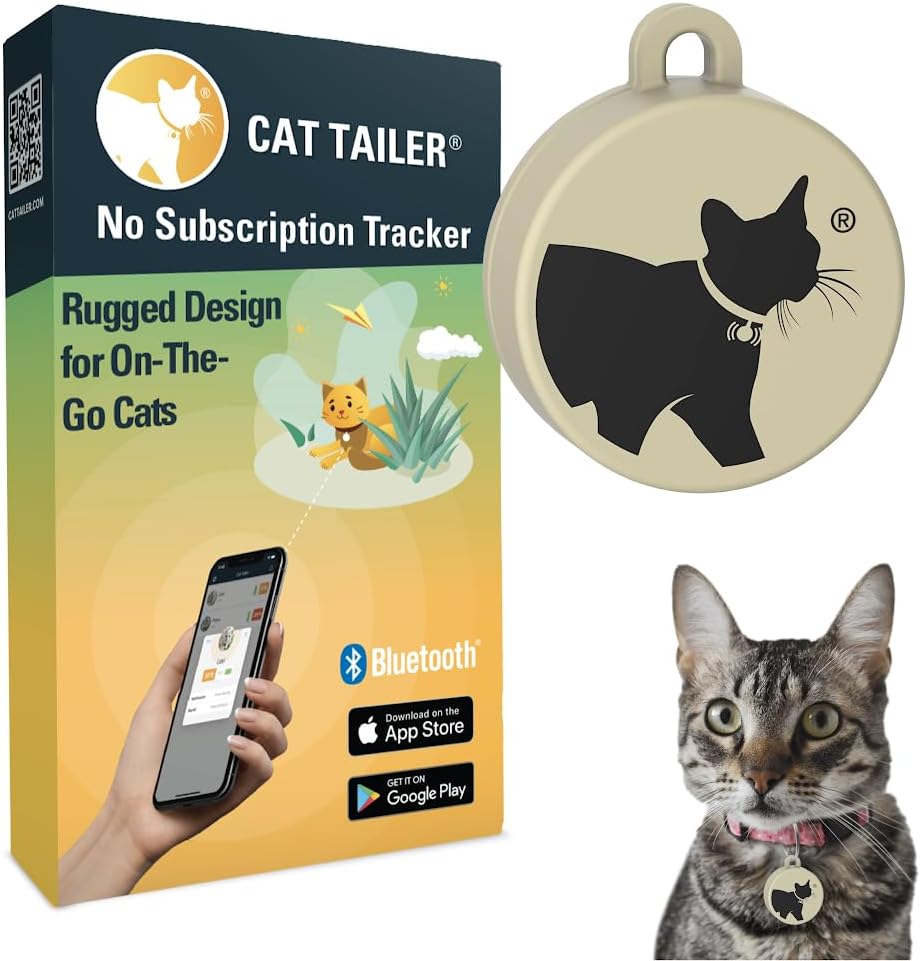
This device is the cat-specific equivalent of the Tile Mate. The Tailer looks like a deep bottle cap and weighs about the same amount as one, making it a good option for cats who won’t tolerate anything larger strapped to their neck. Like the Tile tracker, it’s limited to a very small detection range and won’t be of much help if your cat dashes out the door.
The Cat Tailer’s 328-foot range is broad for a Bluetooth tracker, but weak compared to other devices. Although it can help you once you enter that range, you’ll still have to wander around your cat’s usual haunts until you pick up a signal.
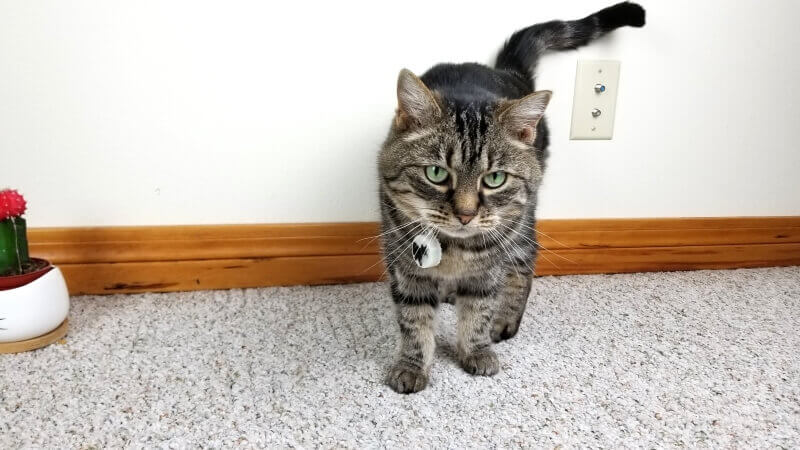
Cat Tailer Bluetooth Cat Tracker. Mallory Crusta / Cats.com
During outdoor tests, the Tailer wasn’t much more helpful than my eyes and ears, losing connection after my testing partner had been out of sight for two minutes. The interface doesn’t give you directional information, so any distance metrics give you only a radius. You’ll have to use trial-and-error to get on the right path.
Even when I did pick up a signal, the Tailer’s location detection was relatively unreliable.
Even though the tracker was sitting on a shelf, the app fluctuated by about 30 feet between scans—as if the Cat Tailer was jumping back and forth across the room. The Tailer’s connection was unsteady, too, sending notifications that the unit had left the tracking range even though I could reach out and touch it.
The Cat Tailer is best-suited to indoor use and cats who tend to behave predictably outside. As long as you’re able to get within range by searching your cat’s favorite haunts, the 328-foot Bluetooth range can help you to narrow things down.
What We Liked:
- A very small, lightweight cat tracker ideal for small cats and kittens
- Extremely easy-to-use app interface
- Can help you to find your cat inside the house or yard
What We Didn’t Like:
- One of the smallest detection ranges of any pet tracker on the market
- Bluetooth signal tends to be inconsistent
#6 Best For Indoor Cats: Tile Mate Bluetooth Tracker
- Type of Device: Bluetooth
- Weight: 6.1 grams
- Battery Life: 12 months
- Includes App: Yes
- Accuracy Level: Low
- Price: Check At Amazon
- Warranty: N/A
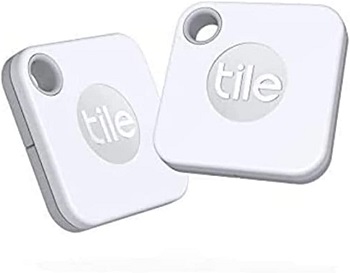
Though not designed for pets, the Tile Mate is an all-purpose Bluetooth tracker that helps you locate lost objects. When attached to your cat’s collar, the Tile Mate can help you to find your cat by connecting to any Tile app within 150 feet. That’s about half the range of our next-most-limited tracker, the Cat Tailer. A 150-foot tracking area could help you to find your cat and give you some degree of confidence, but it’s barely better than your eyes.
In theory, the Tile Mate’s range can expand if it connects to other people’s Tile apps, allowing you to locate your Tile when it comes into the range of any Tile receptor on the planet. It’s reassuring to have the support of the world’s largest lost-and-found community, but not particularly helpful given that you won’t have any idea where your cat went after registering in the Tile system.
Although the Tile was reliable and helpful for tracking down cats inside of the house, it didn’t perform so well in our lost cat simulation. The Tile app couldn’t connect and didn’t share any information about where the tracking unit was last seen.
Subscribing to Tile Premium will buy you a few more helpful features, like smart alerts when your cat leaves the range and access to a 30-day location history.
What We Liked:
- Connects to the Tile user network, which may help you to find your cat if he gets lost
- One of the cheapest tracking options you can buy
- Reliable and accurate for indoor tracking
- Works both indoors and outside
What We Didn’t Like:
- Tile’s use of location services will drain your phone’s battery
- Extremely short tracking range makes it almost useless if your cat roams far from home
#7 Best Cat Tracker in the UK: Weenect 2
- Type: GPS
- Weight: 25 grams
- Battery Life: 3 days
- Includes App: Yes
- Accuracy Level: High
- Price: €49.99
- Warranty: 2-year
The Weenect 2 is a GPS tracker that enables you to track your cat’s location in real time with no distance limit. No matter where your cat goes, you will always be able to find them.
Priced at around €50, the Weenect 2 is an affordable option, but you will have to pay an additional monthly subscription fee for use. This device tracks your cat’s location in real time using a multi-network SIM card that allows it to operate even in the countryside. It won’t, however, work if there’s no cellular service available in your area.
In addition to live tracking, the Weenect 2 offers a variety of monitoring features like territory analysis, location history, and time spent sleeping or playing.
If you ever need to find your cat, simply use the smartphone app to view the GPS location of your cat in one of several modes: maps (classic or satellite view), compass, or radar. What we really love about the Weenect 2 is that it incorporates a training module so you can teach your cat to return home when called. Using the app, you can vibrate or ring the tracker at mealtime and your cat will learn to associate the two events and come running.
Speaking practically, the Weenect 2 performs well and it stood up to most of the promises made on the website. The 3-day battery life isn’t as long as some of the models we tested. And, although the device was very lightweight, we can see how it might be a little big on very small cats.
Overall, we were impressed with the Weenect 2 app and the training feature, though we’d love to see a longer battery life. It’s a great option if you want to know where your cat is at all times.
What We Liked:
- Complete tracking system that shows GPS location in real time
- View activity level, location history, and distance traveled
- Long battery life of up to 3 days on a single charge
- The world’s smallest GPS tracker for cats, includes multi-network SIM card
- Silicone case for waterproof protection, fits any collar or harness
What We Didn’t Like:
- May be too big for some cats to wear comfortably
- Battery life could be longer, only lasts about 3 days
- Requires a subscription plan, £9.99/month or 1- or 3-year paid upfront
#8 Best Multi-Pet RF Tracker: Girafus Pro-Track-Tor RF Finder
- Type of Device: Radio Frequency
- Weight: 4.2 grams
- Battery Life: 30 days
- Includes App: No
- Accuracy Level: High
- Price: $109.99
- Warranty: N/A
The Girafus RF tracker is among the longest-range radio frequency trackers on the market, allowing you to receive signals from up to 1,600 feet away.
Of the trackers we reviewed, the Girafus Pro-Track-Tor demanded the most hands-on assembly time. Between inserting batteries into the tracker and receiver, struggling to snap the case back together, handling tiny screws, and learning how to start a tracking session, it took 18 minutes to put everything together.
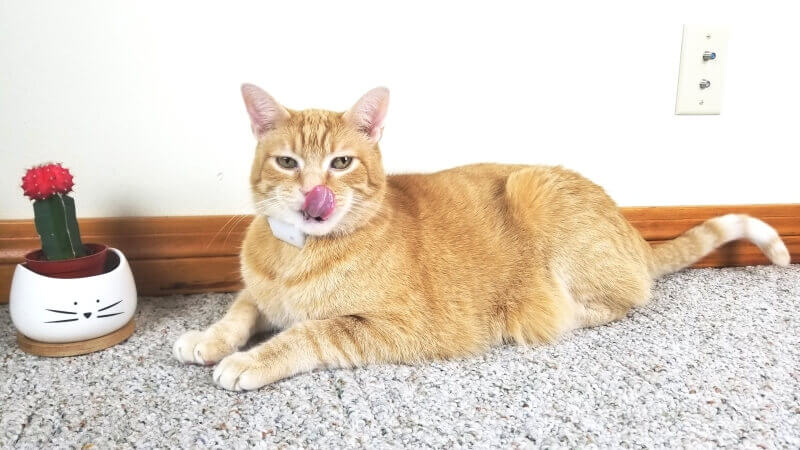
Girafus Pro-Track-Tor RF Finder. Mallory Crusta / Cats.com
The tracker’s silicone case slips over a slim collar—it includes Velcro straps for attaching to larger collars—and sits lightly against the neck. Of the trackers we tested, the Girafus had the lowest profile and was best suited for small cats.
After setup, operating the tracker was straightforward. First, you’ll calibrate the tracker by doing several 360-degree turns. Once the tracker starts picking up a signal, it starts sounding a high-pitched tone and using multicolored lights to indicate the distance between the receiver and the tracker.
Both indoors and out, the Girafus worked consistently well. In the lost cat simulation, I used it to locate the tracker hidden in the woods, and later, when the Bluetooth trackers couldn’t catch a signal, the Girafus Pro-Track-Tor saved the day.
What We Liked:
- The tracker’s 1,600-foot range is exceptional among RF trackers
- Has a battery life of up to 30 days
- Works without any monthly payments
- High level of accuracy
- The smallest, most-cat-friendly tracker on this list
- One handset is compatible with up to 4 trackers
What We Didn’t Like:
- Some customers say that the battery gets loose inside of the tracker, leading to inconsistent performance
- The receiver is clunky and won’t fit in smaller pockets
#9 Best Lightweight Tracker: Fitbark GPS Tracker (2nd Gen)
- Type of Device: GPS
- Weight: 16 grams
- Battery Life: 10-60 days
- Accuracy Level: Mid
- Warranty: 1 year
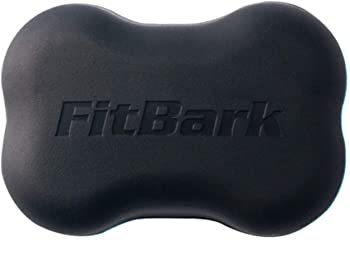
The Fitbark GPS tracker is one of the lightest pet trackers on the market. Released in 2019, the original Fitbark weighed just 17 grams. Fitbark released a second-generation model in 2022 it’s one gram lighter. You can attach the tracker to your cat’s collar using two zip ties (included), so you don’t have to buy a new collar.
This pet tracker uses GPS and cellular technology to track your pet’s location. Using the smartphone app, you can view your pet’s location (updated by the minute) and monitor other aspects of your pet’s health such as mobility, sleep, and anxiety levels.
This tracker requires both Wi-Fi and LTE coverage to work. Though the original Fitbark was only compatible with Verizon LTE-M, the second-generation Fitbark works with Verizon, AT&T, and T-Mobile. The updated model can be synced with most smartwatches including Apple Watch, Google Fit, and Fitbit.
In addition to tracking your pet’s location, the Fitbark GPS tracker sends you phone alerts when your cat enters or exits the designated Wi-Fi zone. Not only will you know when your cat leaves home, but you’ll get a notification when they return as well. You also have the option to create other safety zones such as a friend or family member’s house.
Like many pet trackers, the Fitbark GPS tracker also functions as an activity monitor. You can track your cat’s activity by the minute and keep tabs on things like sleep quality, calories burned, distance traveled, and overall health or behavior. In order to make the most of this function, you should select “Other Pet” when setting up your Fitbark to indicate that your pet is not a dog.
Overall, the Fitbark GPS Tracker is a great option for cat owners if you want real-time alerts on your cat’s location. With the iPhone or Android app, you’ll be notified when your cat leaves the designated safe zone and you’ll get up-to-the-minute live tracking as well. That said, some users report delays in tracking location depending on the strength of cell reception.
What We Liked:
- One of the lightest pet trackers on the market (16g)
- Accurate live tracking on LTE cellular network with Verizon, AT&T, and T-Mobile
- Improved battery life with 2nd Generation, up to 60 days on a single charge
- Monitor your cat’s activity and sync to your own activity monitor
What We Didn’t Like:
- Location tracking may be delayed by poor cell reception
- Requires a subscription for GPS (starts at $5.95/month)
How Do You Know Which Tracker Is Right for You?
While reading customer reviews, researching the market, and testing trackers with my own cats, the reality of cat trackers was obvious. There is no perfect cat tracker. From GPS to Bluetooth and high-priced to cheap, every tracker has something that will disqualify it for someone.
Think about your cat first—will he be comfortable with a large, heavy GPS tracker? Does he roam far away or are you confident he’ll stay within the yard? Is he an indoor-only cat but tends to hide in the closet? These questions will help you decide if your cat needs a GPS tracker, RF tracker, or a small-range device that relies on Bluetooth.
Before you make a decision, think about the cell coverage in your area. If it’s spotty, an RF or network-independent tracker might work best. Also factor in the network provider that the tracker uses. If it relies on Verizon, for example, your tracker won’t work in an area that’s not covered by Verizon.
Finally, factor in price. You’ll find trackers of every category at a wide range of prices, so look for one that fits your budget both upfront and over time.
Relevant Content: