
Word’s Cat Population
Ever wondered how many cats live around the globe? See how many cats call each country home. Explore the latest statistics and compare feline populations around the world.
See the Statistic >Personality and Temperament
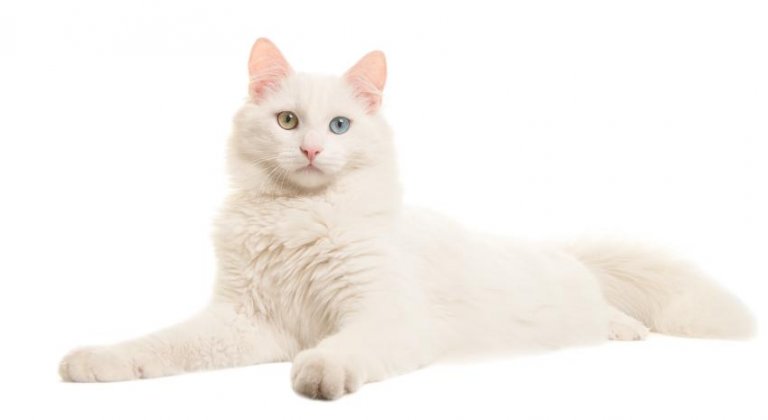
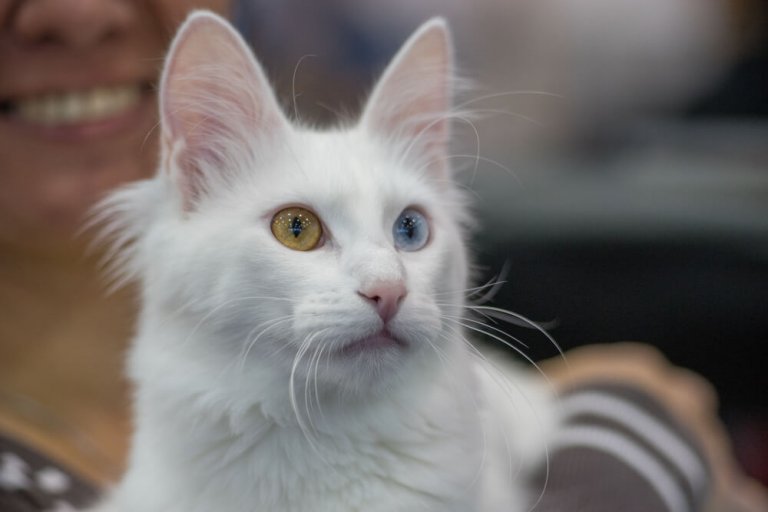
Also known as the Ankara cat, the Turkish Angora has a marvelous personality to match its stunning appearance. Highly intelligent, just a little bit talkative, and beloved for their tendency to develop complete devotion for their favorite person, these cats like to be in the middle of everything, often watching the action without actually joining in.
Of course, Turkish Angora cats do have a playful streak, curiously investigating cupboards, drawers, empty boxes, and everything else they can find their way into. They love games of chase, and can even learn to play fetch. The more you praise a Turkish Angora and applaud their antics, the happier they'll be and the stronger your bond will become.
The Turkish Angora is one of a few breeds that enjoy water. These cats have a fondness for faucets, and given the opportunity, will happily accompany their people into the shower or sit on the side of the bathtub, perhaps dipping a paw to create mesmerizing ripples. Some individuals have even been known to swim!
Although the Turkish Angora cat enjoys attention, members of this breed are a bit less demanding than some other breeds like the Siamese and Oriental Shorthair. As long as Turkish Angoras have plenty of toys to keep them entertained throughout the day, they're fine with spending time on their own and will greet you with great enthusiasm when you return from a long day at work.

Care
Nutrition

Grooming

Exercise

Health

Turkish Angora cats don't have any special nutritional needs, however it's best to offer a high-quality food that contains real meat or real fish as the number one ingredient. You might want to look for a brand that incorporates additional omega fatty acids to support skin and coat health.
Despite having a medium-long coat, the Turkish Angora does a fairly good job of keeping itself groomed. Since Turkish Angora cats have single coats with no heavy undercoat, they are not prone to developing mats. Of course, you're welcome to offer a daily brushing, which your cat will appreciate. Not only is this a great opportunity to bond with your cat, you'll catch any small tangles.
Turkish Angora cats love to play, particularly when others get involved. These cats love to chase balls and catnip mice, and they're fond of teaser wands, too. You'll want to treat your Turkish Angora to a cat tree that satisfies their instinctual need to climb, and they'll certainly appreciate other cat furniture, such as scratching posts and window seats. A well-stocked basket of toys will keep your Turkish Angora entertained.
As a natural cat breed, the Turkish Angora is generally healthy. A few rare conditions can affect Turkish Angoras, including ataxia, an inherited condition that is autosomal recessive. Affected kittens display tremors and typically do not survive to adulthood.
Some Turkish Angora cats (usually male) develop a heart condition called hypertrophic cardiomyopathy (HCM) at middle age. In addition, some Turkish Angoras, particularly those with white coats and blue eyes or odd-colored eyes, are born deaf, or with deafness in the ear on the same side as the blue eye.
History
The Turkish Angora cat evolved naturally in the mountains of Turkey many hundreds of years ago. The earliest written records of the breed trace back to France in the 1500s. Long-haired cats made their way to Britain and France as early as the late 1500s, coming from Russia, Persia, and Turkey. It's likely that some of these were Turkish Angoras.
In the early 20th century, European cat fanciers and breeders bred Angora cats to other long-haired breeds, including Persians. Before long, so much interbreeding had taken place that purebred Turkish Angora cats nearly became extinct. The cats were impossible to find outside of Turkey, where the breed is considered to be a national treasure.
In the early 1900s, Turkey's government and the Ankara Zoo developed a breeding program aimed at preserving the Angora cat breed. White Angora cats with blue eyes, gold eyes, or odd eyes (one blue eye and one eye in green, green-gold, or amber) were a main focus of the breeding program.
In 1962, a U.S. Army colonel named Walter Grant was stationed in Turkey. He and his wife exported a pair of Turkish Angora cats to the United States. These cats came with pedigrees and interest in the breed grew rapidly. Even though it was difficult to import Angora cats, more breeders joined the effort and these beautiful cats once again proliferated in the West.
The Cat Fanciers' Association (CFA) accepted Turkish Angora cats for registration in 1968, and in 1970, allowed provisional competition. In 1972, CFA granted the Turkish Angora championship status; however, this only applied to white Angoras. In 1978, CFA accepted all Turkish Angora cat colors for championship. All CFA Angora cats must have lineage that can be traced back to Turkey. Today, the Turkish Angora is recognized by major cat registries worldwide.
The Breed Standard
Eyes
Legs & Paws
Tail
The Breed Standard
Body
Head
Ears
Coat
Color
FAQ
How much does a Turkish Angora cat cost?
Turkish Angora cats cost between $1000 - $2000.
How big do Turkish Angora cats get?
Turkish Angora cats tend to be small in size. A fully grown Turkish Angora cat might weigh between 5-10 pounds or more and range in height anywhere from about 8"- 10" inches tall.
How long do Turkish Angora cats live?
The Average lifespan for Turkish Angora is 15-18 years.
Do Turkish Angora cats shed?
Turkish Angora are long-haired cats, so you do have to expect a certain amount of shedding from this breed, but they don't shed as much as other cat breeds.
You Might Also Like
Why Do Cats Hate Water?

All About Majestic Orange Tabby Cats

13 Affectionate Cat Breeds That Love to Cuddle

7 Cat Breeds That Actually Like Water

Tabby Cats – Colors, Lifespan, Personality, and Fun Facts

12 Smartest Cat Breeds – Most Intelligent Cat Rankings
7 Garfield Cat Breeds Worth Purring Over
14 Beautiful White Cat Breeds That Turn Heads
12 Rare Coat Colors and Patterns in Cats

The Different Types of Black and White Cat Coat Patterns

Tortoiseshell Versus Calico Cats: What’s the Difference Between Them?

The 10 Largest Cat Breeds—Biggest House Cats in the World
Hi 👋, how can we help?
I took my little lady home with me about two months ago, my mom adopted her eight years ago when she was 7yrs old. Now she adores my husband and I but is a complete terror with my 6 other cats, although she appears to like one of them, who is the only one that matches her coloring lol She has decided to rule the house from her main territory, the kitchen. She was extremely skinny when we got her, you could feel every rib and vertebrae when you petted her – I think she’s got a hyper thyroid and appears to be deaf. However she is starting to put on a little weight now and is very happy with her new mom and dad,. She’s affectionate with us, doesn’t mind being picked up and carried around, when she’s in the mood for it. She eats like a crocodile. Mom said she only ate Fancy Feast but she now appears to love boiled chicken more than anything else — yes, we grocery shop and cook for our cats lol I am a domestic zoo keeper and proud of it – they are family after all. We were never able to have children.
I adopted a 6-month old male/neutered (possible?/mix?) Turkish Angora kitten (named “Doc”) at a cat-rescue a few days ago, now living with us (total of 4 days) with my 3 other “rescue” cats (one: 14 year-old orange tabby; two: recently adopted in September 2021, a 2-year-old female/neutered/mix Snowshoe; and three: recently adopted in September 2021, a 6-month old female/neutered/mix, flame-point Siamese; & an older, 13-year-old) rescue long-haired/female/neutered Dachshund adopted in 2009 from the SPCA). All of my critters get along pretty well except that my “newest addition” (my possible Turkish Angora male/neutered male), enjoys being held by me (still a bit skittish but purrs loudly when petted and also uses his litter-box properly), and cruises around our home and meets nose-to-nose with our other 4 pets without incident, but a little bit of “hissing” from the other 3 cats. Also my dachshund thinks that he’s another “cat” !! Anyway, my newest “Turkish Angora” kitten is learning “the lay of the land” in my home but I was wondering how I can tell whether he is a Turkish Angora or possibly mostly a mix of other long-haired cats (i.e., part Persian, part Himilayan ??) since his tail isn’t quite as full and brushy as some of the photos I’ve seen of true-to-the-breed Angora cats. His body fur is extremely soft (the softest cat I’ve ever held), and his coloring is mostly white (with some grey-colored patches) with both eyes being gold and somewhat almond-shaped. When I adopted him last Saturday (4 days ago), he weighed 7 pounds (at age 6 months as a kitten), and he is small-boned but looks much larger than a 6-month-old kitten due to his fluffy hair throughout his body. I wasn’t planning on adopting a Turkish Angora cat when visiting the “Cat Rescue” but I think I’ll keep this beautiful cat since he is so unusual in his fluffiness. His tail is dark grey (all one color), and also has grey “tabby markings” (with the “M” in grey) on his head. Could anyone share with me what he/she knows about these Angora cats and what I should expect when raising him (for the next 15-20 years)? I have owned (adding those sbared with my husband) a total of 10 cats over these past 70 years, so this is not my “first rodeo” when it comes to having a cat in the home. I also have alot of patience when taking care of these loving pets ! Thanks !
Melinda, the thing with cat breeds is that, unless you have papers, you can’t say that the cat is a purebred, period. And 99% of the time, even the cats we might assume are “mixes” of different breeds simply aren’t. While most of our dogs were bred into existence and, hence, all mutts are crosses of distinct breeds, the practice of selectively breeding cats has only been around for about 50 years. Therefore, the vast majority of felines out there can’t even be considered mixes—they are just, well, cats! I doubt that Doc is some mix of Persian, Himalayan, Turkish Angora, or any other pure breed—such a thing seldom occurs as purebred cats are usually only bred under controlled conditions (with other cats of the same breed) or, if they’re not to be bred, carefully raised, then spayed and neutered. Therefore, I wouldn’t assume that your kitten is a Turkish Angora or a mix at all. Instead, I would call him a domestic longhair—that’s the term we use to describe any non-pedigreed longhaired kitty. Sounds like a great cat and an excellent addition to your crew. Hope this helps you figure things out! 🙂
Mine doesn’t have as bushy a tail either and she’s all white smooth as butter but she hits all of these characteristics personality wise and her front legs are stubby
they are family after all
Gina,how can a cat be ”part of your family” ? Suppose one of your cats had babies. There were too many to keep, so you gave some away. Then would you say that you were giving away your grandchildren?
I don’t know what kind breed I have . It color is tabby ginger but it’s fur is getting long has a long tail. He is very friendly and playful. I think he is 3-4 month old also has a long body
Belen, your cat would be considered a domestic longhair, I believe!
Mallory,
I appreciate your comment on “long hair” classification. I think breed characteristics are general and if it’s a rescue the are a lot of factors that affect its demeanor, which is most important. I am looking to adopt a deaf TA girl hoping it will enjoy my 2 wonderful boys to pal with and to get some idea of what I might expect in terms of making her a part of our happy family.
I’ve been lucky to have found 2 turkish angoras at shelters, one over 10 years ago and I’ve had my current one about 3 years. If they both aren’t turkish angoras, then I’m a monkey’s uncle! They fit the description to a t., no papers to prove it but my 2 all white beauties are show quality angoras in my opinion. I have only one now and pure bred or not, she’s my constant companion and I love her dearly. Everything I’ve read about the breed is true, from their fondness of faucets to their high level of intelligence. Anyone thinking about adopting a turkish angora, don’t hesitate, but be prepared to give this cat the devotion it will give to you.
I understand that many people take their cats very personally, and that is absolutely expected (and wonderful), but creator of this website really provided proper information for breeds that were listed.
Just to say, before getting into Turkish Angora point, me and my family had (and still have) many stray, rescued cats since I can recall, some of these were even badly injured, blind and we took care of them all (and still do for some of our seniors who are still alive – and very old but happy and healthy). We love cats, and we support adoption, and do just that.
However, since Turkish Angora is my personal favourite breed, I also have purebreds, all white, which I legally obtained and payed for, with pedigree and full paperwork from registered, respectable breeders.
I also own mixed Turkish Angora, also white (with Turkish ancestry from Ankara (from her mother side – she was bred with mixed T.Angora and Maine Coon male, and this breeding resulted with our beautiful cat. She is also obtained from a breeder, but not registered since she is a mixed breed.
My grandma also owned real Turkish Angora (from Ankara) and we also had a rescue that LOOKED like Turkish Angora, but since it was a rescue, it was a moggie, no papers. All these are/were white. (we are in Europe).
What I wanted to say with all this writing is that there is definitely a difference in appearance and character of purebred Turkish Angora, mixed breeds and moggies.
And (outside Turkey, since they consider all Turkish cats Angoras), only a purebred cat with paperwork can be considered “Turkish Angora” breed (as stated by both our veterinary and by TICA judges. And since these cats are bred to obtain these specific characteristics (both in look and character), they fit well into description that is provided. Just saying, good info is provided here.
We love all our cats the same, but our purebreds are completely different in character and built, (and also size, how they walk and carry themselves) from our T.A mixed breed and our (possible) T.A. moggie.
Also, when signing Your pet in respectable veterinary clinic and creating pet passport, only cats with paperwork and pedigree can be listed as a specific breed (at least in many countries in Europe). So only our pedigreed Turkish Angoras are “Turkish Angoras” in their passports and medical cart, while our T.A./Maine Coon mix is just as moggie as the rescued moggie that looks like Turkish Angora.
Again, just saying, because no matter if you get a mixed breed of T.A. from a breeder that has no pedigree, from a shelter or from a street, this is still a moggie even if it really looks like T.A. (that is if You don`t get it directly from Turkey which is not really that easy!).And all cats are unique and gorgeous in their appearance and character in their own way, but there is a difference between purebreds and moggies. And again, we love them all the same 🙂
Thank you for the thoughtful and informative comment. 🙂
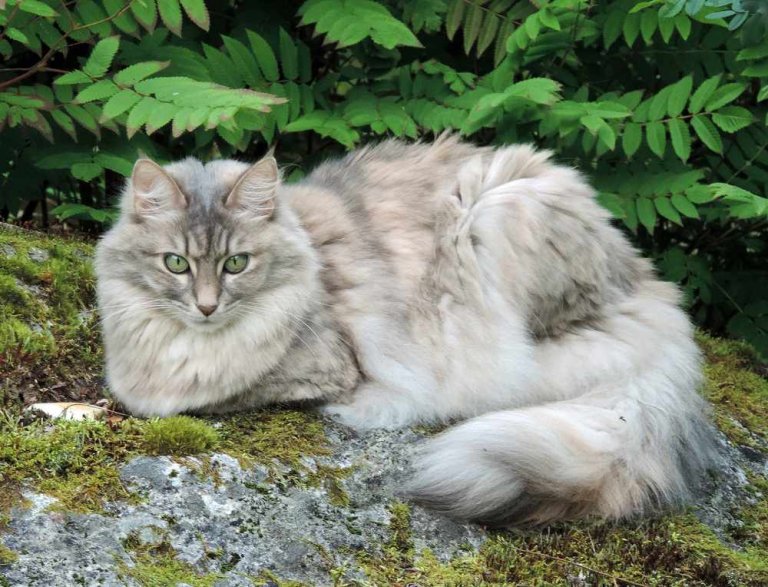
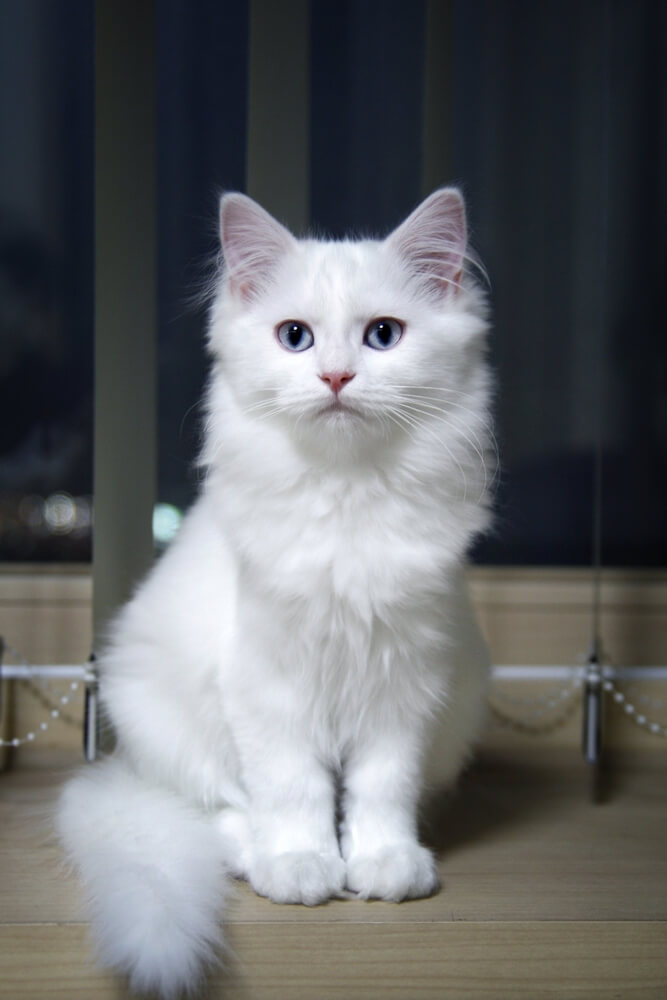
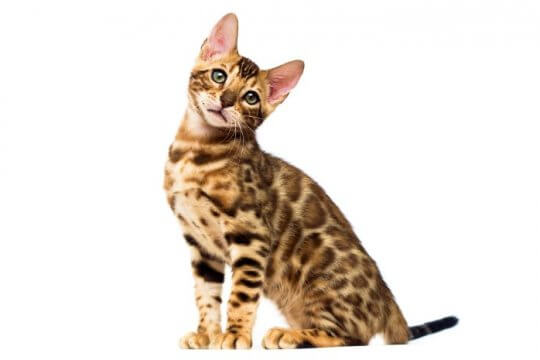
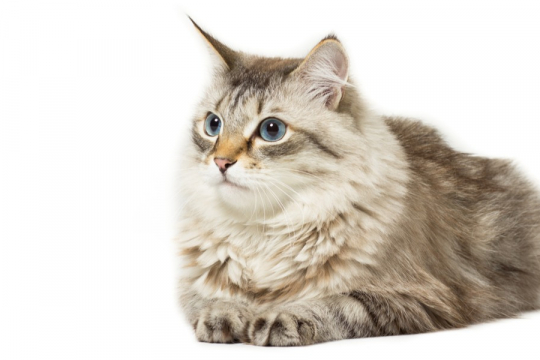
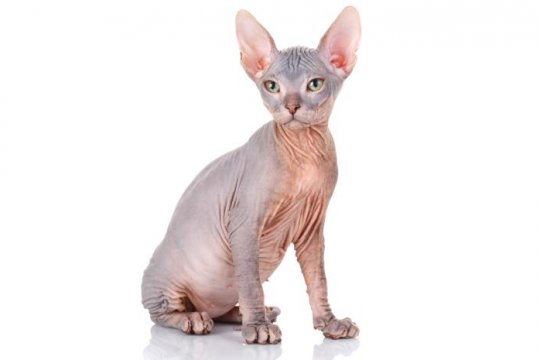
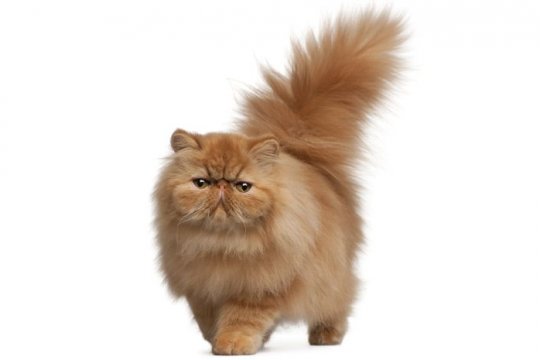
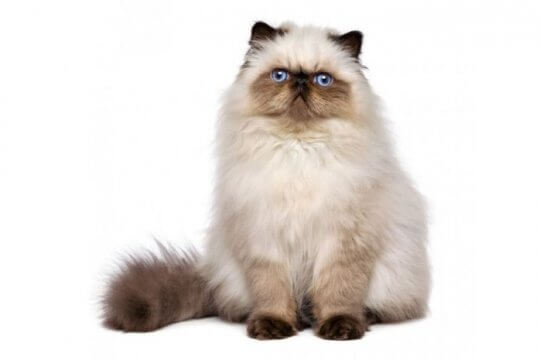
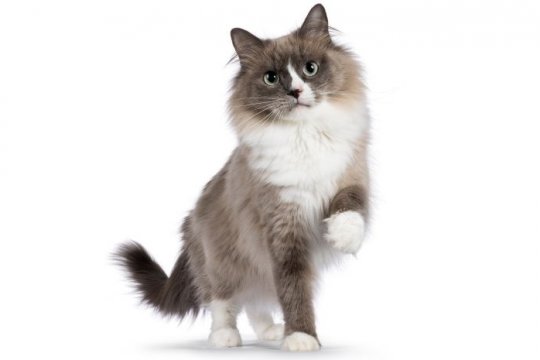
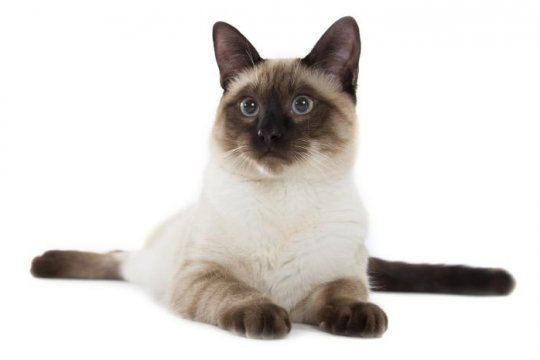
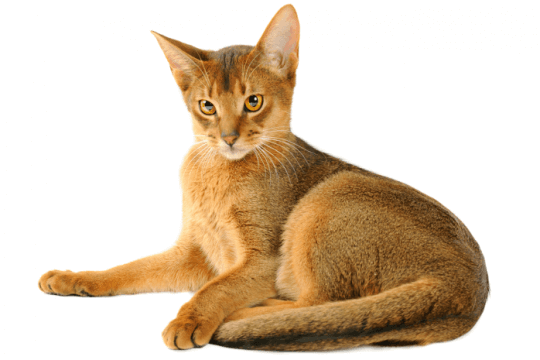
These don’t look like Turkish Angoras. The faces are all wrong. It looks like you found a couple of white long hair cats and then randomly pick two more long hair cats.
Thank you for the feedback. I’ve passed this along to the team so we can correct the photos.
I worked in the “Humane” society for 2 weeks, just long enough to find an amazing white turkish angora with a blue and a green eye…or should I say he found me? He virtually hypnotized me the day I met him. He watched me carefully as I passed the window to his room. When I came in to clean his cage he stepped from side to side to allow me to clean it. He never cried out-just stared at me with those mis-matched eyes. I went to my boss and asked how to adopt a cat and she started saying after 30 days I coul- I cut her off-“I mean how can I adopt it today?” I threatened to quit when she started reciting the policy again-and she made a special exception! I quit a week later when I started being asked to euthanize animals. Obviously this cat pulled some strings just to get me the job. He would run across the room as I held my arm out with my fingers like a claw and jump up, holding his weight for 2 seconds on my arm and drop down to the ground and strut away. I’m 6′ tall and he would never leave a scratch! Sadly, I lost him in a blizzard(true story)on our way to California. He apparently had other plans and I have no doubt he knew where he was going.
Thanks for sharing your story of connection with this special kitty!