
 Last updated Sep 8, 2022



Fenbendazole is a broad-spectrum dewormer commonly used in veterinary medicine to treat pets for a variety of nematode (worm) and protozoal parasites. Common brands include Panacur and Safe-Guard.
In this article, you’ll learn what fenbendazole is, how it works, and the types of parasites in cats it may be used for, as well as some frequently asked questions.
Fenbendazole for Cats Overview

About Fenbendazole for Cats

Fenbendazole is classified as a benzimidazole antiparasitic agent and has a very wide range of effect against a variety of internal parasites.
Microtubules are structures within cells that assist in transport of materials within the cells. Fenbendazole acts to disrupt this transport system in affected parasites. At higher doses, it may also disrupt metabolic enzymes and pathways of affected parasites.
What Does Fenbendazole Do for Cats?
Fenbendazole can have efficacy against a variety of internal parasites commonly found in cats, including roundworms, hookworms, whipworms, lungworms, the protozoal parasite Giardia, and several others.
While it is helpful to know what fenbendazole does treat, it is also important to be aware of what it does not treat.
While it can be used to treat tapeworms, this is only for tapeworms of the Taenia species. Dipylidium caninum, which is more commonly seen in cats when they ingest a flea, requires a different dewormer for treatment.
Fenbendazole also does not have efficacy against coccidian parasites like Isospora, which may sometimes be seen in a cat’s stool sample and/or cause gastrointestinal disease.
It is not effective against Toxoplasma gondii, which causes toxoplasmosis, the disease human physicians often counsel pregnant women about in regards to avoiding contact with a litter box or cat feces during pregnancy.
Heartworms, which are not intestinal worms, but are transmitted by mosquitoes and dwell in the major vessels near the heart as well as the heart chambers themselves, are not affected by fenbendazole. While not covered here, there is no approved treatment for heartworms in cats.
Side Effects of Fenbendazole for Cats
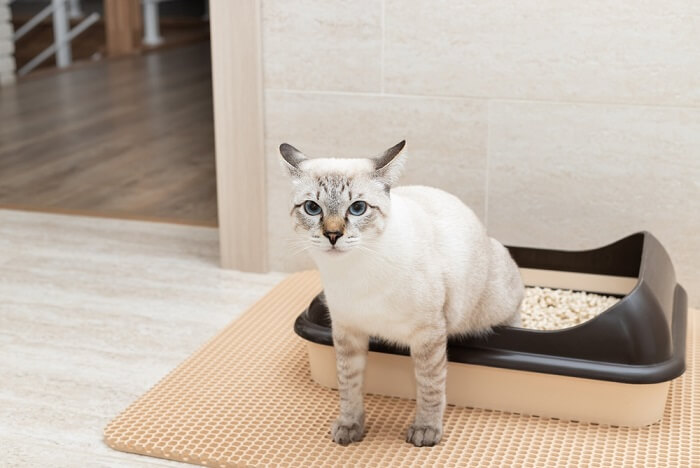
Some cats may experience temporary diarrhea while taking fenbendazole.
At appropriate dosages, fenbendazole does not typically cause any adverse reactions on its own. Infrequently, drooling, vomiting, or diarrhea may occur.
It is important to remember that the job of any dewormer is to kill internal parasites. This means that sometimes, a reaction may occur to components released by a dying parasite, especially in cases where a very high parasite load is present.
In these cases, drooling, vomiting, diarrhea, or GI discomfort may be more likely to be seen. Typically, these signs are temporary, but if concerning, should be reported to an attending veterinarian in case some supportive care is needed.
Fenbendazole for Cats Dosage
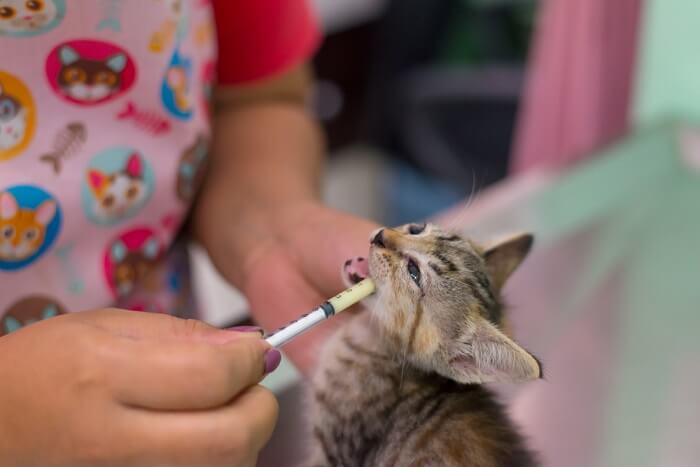
Your veterinarian will tell you the proper dosing for fenbendazole, which is determined by weight.
While it is FDA approved for use in dogs, fenbendazole is not labeled for use in cats and all dosing is considered extra-label in kitties.
For this reason, any products labeled only for dogs, including over the counter products like Safe-Guard, should be reviewed first with your vet to determine what dose will work best for your cat.
Dosing depends on body weight. Duration of treatment with fenbendazole depends on the type of parasite, where it may be used for anywhere from three to up to 10 or more consecutive days.
Remember that not all digestive disturbances are caused by intestinal parasites and fenbendazole does not treat for all potential parasites. Any use of a dewormer should be based on results of a fecal/stool sample or otherwise as directed by a veterinarian.
Fenbendazole only comes in powder or liquid suspension forms that are appropriate for use in small animals. The powder can be tricky to properly portion out and dose for some smaller cats and kittens, another reason to refer to your vet for proper instructions.
The liquid oral suspension requires a prescription, but comes in a 1 liter bottle size, making it impractical as a choice for a single treatment course. Veterinary practices typically dispense individual doses or smaller dosage volumes to use for treating a cat or kitten for susceptible parasites.
The syringe paste intended for use in horses is also impractical to use in cats, as they typically require doses much smaller than the increments on the syringe.
Conclusion
Fenbendazole is a very effective and safe broad-spectrum dewormer used commonly to treat cats and kittens for a variety of internal parasites. It is important to remember however that it does not treat all parasites, and not all digestive disturbances are caused by parasites. That’s why it’s important to work with your veterinarian to determine if using fenbendazole is appropriate.
Frequently Asked Questions
How much fenbendazole can I give my cat?
The dosage amount will depend on your cat’s weight and the form of fenbendazole available. To ensure proper dosing, as well as to confirm whether or not fenbendazole is appropriate to give your cat, it’s best to talk to your veterinarian.
Is fenbendazole safe for cats?
Yes, fenbendazole is generally deemed very safe for cats. On occasion, some mild digestive upset may occur. Digestive upset may be more common when fenbendazole is used to treat cats with high parasite loads and the dying parasites cause disturbance in the body.
Can cats be dewormed with fenbendazole?
Yes, although it depends on what worms a cat is infected with. Use of a dewormer should always be based on a stool/fecal sample or similar testing for the presence of parasites. In cats, fenbendazole is most effective against roundworms, hookworms, lungworms, and the protzoal parasite Giardia.
How do you give fenbendazole to a cat?
This depends on the form being used. If you have been provided with the powder form, it’s often easiest to give to a cat mixed with wet or soft food, both to hide the taste, but also because it may be more effective when given with food.
If you have the liquid suspension form, it may also be mixed with wet or soft food if your kitty will take it that way. However, it may need to be administered directly by mouth with a syringe that your veterinarian should provide you. This is especially the case with small cats and kittens.
If you have difficulty administering fenbendazole to your cat, make sure to touch base with your vet to discuss additional ideas, see if a different dewormer may be effective, or to set up an appointment for veterinary staff to administer the dewormer for you.





Not helpful!
Hi Fred, sorry to hear that. Let us know if there’s anything we can do to help.
My cat, only 4 years old and 10 lbs, has been diagnosed with cancer in the neck of his bladder; inoperable! He’s already taking Metacam. I have ordered CBD oil from Penelope’s Bloom and would like to start him on Fenben, as well. What is the recommended dosage? Also curcumin! Do you have any recommendations? My vet was ready to euthanize him, right after diagnosis; he’s playful and happy to be alive! We love this beautiful boy so much, but will NOT allow him to suffer. As long as he has quality of life, we want to keep him happy and alive! Thanks so much, it’s not easy to type while crying!
Hi Terry,
I’m very sorry to hear about your kitty. If this is truly a bladder neck tumor like transitional cell carcinoma, surgery in that area is often not a great benefit compared to the complications and risks of trying to do it. On top of the risk of scar tissue occluding the urethra and/or urinary incontinence that may result, the tumor may recur if margins aren’t possible.
If you feel your cat’s quality of life is still very good, I don’t feel it’s wrong to value the time you have together until something changes.
Be very vigilant with the metacam. NSAID medications can help slow down bladder tumors and are reasonable to consider but carry risks in cats as well.
I can’t advise a specific curcumin supplement, but it is important to look for a supplement that is actually curcumin and not just turmeric. Some turmeric supplements may have very little actual curcumin in them.
I’m a little puzzled by your interest in starting your cat on fenbendazole in relation to this disease as it does not have any anti cancer or anti-inflammatory properties that I’m aware of. It is simply a dewormer. Was there a specific reason for your desire to use it? Or perhaps you’re thinking of a different medication?
The vet is treating my 18 yo BFF the same because of a fast growing mouth ulcer that the vet thinks might be cancer. I bought the goat formula of fenbendazole. It is liquid and easy to dose by weight. My boy is only 14lbs so the dose is 3ml once a day. Just started 6 days ago.